

Dee’s 12 all-Time Favorite Books
for Addiction Recovery
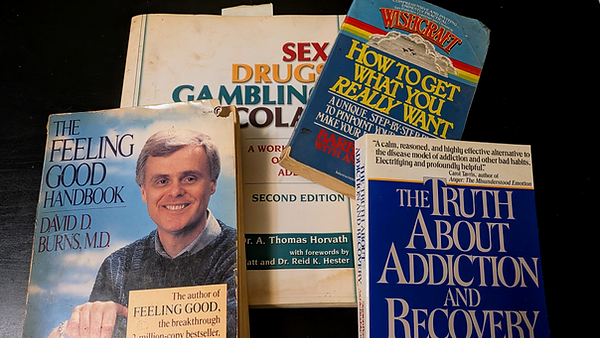
These books have helped see me through life, in recovery, and more generally, starting with David Burns. I've ended up mostly an Albert Ellis devotee for the simplicity of his overall framework and logic, which I encountered initially at SMART Recovery and then the expansiveness and good sense of Stanton Peele has been vastly influential. This is a short list. These are the ones I have right in my bookcase. They're all solid books, mostly based on science or simple common-sense, and they've truly shaped my life! I hope you enjoy them.
Disclaimer: these are not currently monetized links. They are just straight up links to the books on Amazon. If that changes, I will let you know.
1. Feeling Good, David Burns
Feeling Good isn't an addiction recovery book, per se, but it is a psychology self-help book, in the best sense, that teaches readers how to use cognitive behavioral therapy (CBT) to overcome depression. Friendly and authoritative, David Burns describes the CBT framework created by its originator, Aaron Beck, and how to apply it in clear, easy language. That is, that our thoughts and beliefs highly contribute to our emotional state, and that by changing our thinking, we can change our mood. He identifies cognitive distortions, gives sensible reassurance and has a great array of tools to help assess and improve mood and thinking.
2. Love & Addiction, Stanton Peele & Archie Brodsky
Explores the relationship between love and addiction. The authors argue that love can be addictive--as addictive as heroin--with sometimes equally deadly results. The book provides insights into the psychology of love and by extensions forces a look at addiction overall, in offering advice on how to overcome them.
7 Tools to Beat Addiction: A New Path to Recovery from Addictions of All Kinds, Stanton Peele
Offers a new approach to addiction recovery. Peele argues that traditional addiction treatment methods, such as 12-step programs, are often ineffective and can even be harmful. He presents a new model of addiction recovery, the Life Process Model that is based on the principles of cognitive behavioral therapy (CBT).
3. The Truth About Addiction and Recovery, Stanton Peele
Challenges the conventional wisdom about addiction. Peele argues that addiction is not a disease, but rather a learned behavior. He also argues that traditional addiction treatment methods, such as 12-step programs, are often ineffective and can be harmful.
4. 3-Minute Therapy, Michael Edelstein
Teaches readers how to use cognitive behavioral therapy (CBT) to overcome common mental health problems, such as anxiety, depression, and stress. The book is divided into 3-minute exercises that readers can use to challenge their negative thinking and develop more positive thinking patterns.
5. The Cracker Factory, Joyce Rebeta-Burditt
A memoir about the author's experience of being institutionalized for mental illness and drinking. The book is a powerful and moving account of the author's struggle with mental illness, and her eventual recovery. This was really dated, even when I first read it, but I found it, somehow, very charming and reassuring. She hit on something for me.
6. The Happiness Trap, Russ Harris
Teaches readers how to overcome negative thinking and live a happier life. It describes the principles of Acceptance and Commitment Therapy (ACT), a type of psychotherapy that has been shown to be effective in treating a variety of mental health problems, in simple clear language, examples and easy, effective exercises.
7. A Guide to Rational Living, Albert Ellis
One of the founders of modern psychology, Albert Ellis explains how to use rational emotive behavior therapy (REBT), a very similar branch of CBT, to overcome emotional problems. Ellis argues that our emotions are largely determined by our beliefs, and that by changing our beliefs, we can change inappropriate, exaggerated and out of control emotion to more appropriate expressions. The book includes practical exercises that readers can use to challenge their irrational thinking and develop more rational thinking patterns. REBT forms the framework of most of my thinking. I've found it a reliable and sturdy way to view and act in the world.
8. Do It Now! Break the Procrastination Cycle, William Knaus
Lays out how to overcome procrastination. Knaus argues that procrastination is often caused by fear of failure, fear of success, or fear of change. He offers a variety of strategies for overcoming procrastination, including breaking down tasks into smaller steps, setting deadlines, and rewarding yourself for completing tasks. He applies REBT tools in this area, which has much overlap with addictive issues.
9. Wishcraft, Barbara Sher
This is a favorite of mine, and it is more about finding and pursuing one's life dreams and purpose. It guides readers in how to identify and pursue their goals in fun, easy language. Barbara Sher is very engaging as she explores why stop ourselves from pursuing and achieving our true passions and dreams and how to stop! She offers a variety of simple, practical strategies for overcoming self-sabotage and achieving our goals, for regular people. She is not clinical. She isn't a psychologist. Just sensible, practical and inspiring. Although, much of what she suggests is nestled firmly in sound psychology.
10. Get Your Loved One Sober: Alternatives to Nagging, Pleading and Threatening, Bob Meyers, Brenda Wolfe
For people who have a loved one struggling with addiction, Get Your Loved One Sober, offers practical advice on how to help your loved one get sober, without a punitive, tough-love approach. The book describes CRAFT (Community Reinforcement and Family Training), the evidence-based approach for families they originated, to help loved ones, while maintaining their own health and well-being. This book is a classic I turn to over and over again. I have found their work an excellent companion to REBT and it is such a refreshing approach for families who are weary and in desperate need of some encouragement and support.
11. Beyond Addiction: How Science and Kindness Help People Change, Jeffrey Foote, et al.
Explores the science of addiction and recovery, also in the framework of CRAFT. It offers an up to date and comprehensive expansion of Dr. Meyers and colleagues’ work. It is a big book, but it is easy reading and combines a nice informational and conversational tone. And you can flip around to the topics that are of interest. This book is invaluable to those with issues other than alcohol. Highly readable!
12. Sex, Drugs, Gambling, and Chocolate: A Workbook for Overcoming Addictions, Tom Horvath
Written by former long-time president of SMART Recovery. This is a great resource for those with any variety of addictive behavior.